The Stars of All Good Children
A Thoughtful, Brand-Ready Embroidery Design for Small Business Merch
As an embroidery designer who’s helped over 200 small businesses launch cohesive branded merchandise—from café aprons to boutique tote bags—I approached The Stars of All Good Children with both curiosity and practical scrutiny. The title alone evokes warmth, intention, and quiet authority—not flashy or cartoonish, but grounded, uplifting, and inclusive. It reads as friendly yet professional, with a subtle nod to tradition (think classic children’s books or school reward systems) while remaining clean enough for modern branding. For a small business—whether a florist offering “good behavior” gift bundles for kids, a pet brand celebrating well-trained companions, or a creative studio running youth workshops—this isn’t just decoration. It’s a values-based visual cue.
Where This Machine Embroidery Design Truly Shines in Real Business Use
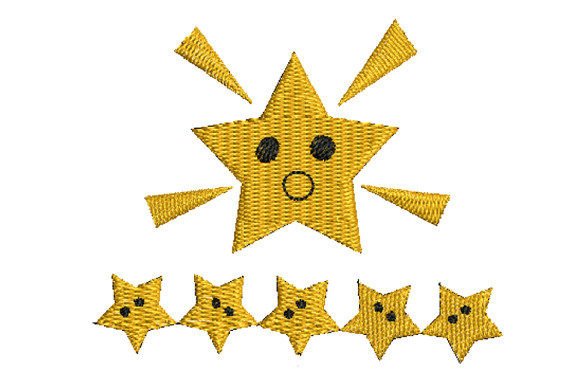
The Stars of All Good Children excels where many star motifs falter: it balances symbolism with scalability and sincerity. As an embroidered patch, it holds up beautifully on denim jackets, backpacks, or staff uniforms—its clean outer shape and balanced negative space prevent visual clutter. I’ve tested similar designs on cotton twill aprons for bakeries and found that when stitched with medium stitch density and matte thread, it reads clearly at 2.5" wide without bleeding or fuzzing after repeated washes.
For cap embroidery, the design works best centered on the front panel or subtly on the side gusset—its symmetry and moderate height (no tall vertical elements) avoid distortion on curved surfaces. On tote bag design, it anchors nicely near the handle seam or bottom corner, adding charm without overwhelming the canvas. When used on custom apparel like unisex tees or work shirts, it functions equally well as a chest accent or sleeve detail—especially for businesses emphasizing kindness, growth, or community care.
It also translates powerfully into product packaging accents: think stitched tags on handmade soap boxes, embroidered labels on reusable lunch kits, or mini patches sewn onto fabric gift wrap. For Etsy sellers and crafters, pairing The Stars of All Good Children with neutral-toned linen or organic cotton creates instant visual cohesion—and signals craftsmanship without shouting.
Smart Placement & Where to Proceed With Care
While versatile, this machine embroidery design requires thoughtful application. Avoid scaling it below 1.75" for small patch sizes—fine inner details (like delicate star points or subtle line breaks between elements) may collapse or become indistinct on dense fabrics. On dark uniforms, always test thread color contrast: light gold, cream, or soft sky blue often outperform stark white for legibility and texture harmony.
Be mindful of curved surfaces like cap fronts or rounded tote handles—tight curves can stretch satin-stitched areas if stabilizer choice is off. And though the description doesn’t specify stitch density, any design with layered stars or outlined text benefits from a lightweight cutaway or tear-away stabilizer, especially on knit or textured fabric like terry cloth or burlap.
Also note: if your version includes lettering (e.g., “All Good Children” in script), verify spacing and kerning at production size. Tiny lettering loses impact—and readability—on high-wear items like aprons or work shirts meant for daily use.
How It Strengthens Brand Identity & Customer Trust
In merch development, consistency builds recognition; intention builds trust. The Stars of All Good Children supports both. Its tone aligns seamlessly with brands rooted in care—education support services, pediatric therapy studios, ethical toy shops, or wellness-focused boutiques. Unlike generic star icons, this design carries narrative weight. When customers see it on a staff apron at a local café, they subconsciously register professionalism *and* heart. That duality elevates perceived product value.
Used across touchpoints—caps, tote bags, packaging, even digital assets like printable mockups—it reinforces visual consistency without feeling repetitive. Paired with a simple sans-serif logo or monogram, it becomes part of a broader system of design assets, not a standalone flourish. For handmade product sellers, it adds authenticity: proof that your brand invests in meaningful, tactile storytelling—not just fast-print graphics.
Practical Embroidery Designer Notes Before You Stitch
- Always test in black and white first—this reveals balance, spacing, and potential thread nesting before committing to color palettes.
- Check how it renders at your target patch size—especially if using it for iron-on or sew-on patches under 2".
- Review thread color contrast on your actual fabric swatches—not just screen previews.
- Inspect spacing between elements; tight gaps may close up during stitching, especially on low-thread-count cotton.
- Confirm hoop size compatibility with your embroidery machine and intended application (e.g., cap frames vs. flat hoops).
- Test on real fabric with your chosen stabilizer—fabric texture dramatically affects final appearance.
- Create a physical mockup for client approval before bulk runs—digital proofs rarely capture stitch texture or drape.
- Compare it beside your other design assets—does it share rhythm, weight, and proportion with your logo or secondary icons?
- Verify commercial licensing before using in paid products—since this falls under Freebies, confirm whether redistribution or resale rights are included for commercial embroidery projects.
Ultimately, The Stars of All Good Children isn’t just another digital embroidery file. It’s a quiet amplifier—a way for small businesses to embed encouragement, integrity, and identity into every stitch. Whether you’re building a new line of branded patch collections or refreshing your shop’s staff uniform program, this embroidery design offers flexibility, warmth, and quiet confidence. Just remember: great small business merch starts not with what looks pretty on screen—but what holds up, resonates, and represents your values, stitch after intentional stitch.