Teach Apple Pencil
A Whimsical School-Themed Stitch That Feels Like a Hand-Drawn Smile
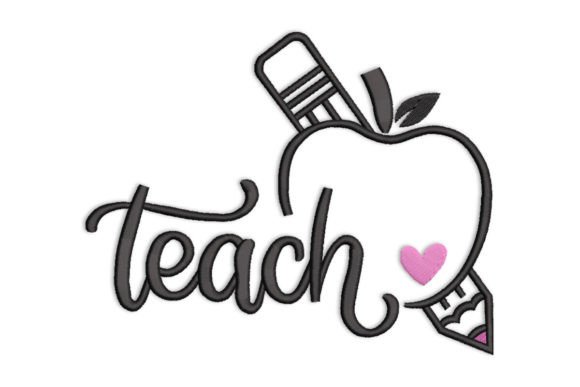
First glance at Teach Apple Pencil—yes, that’s the full, charming title—and I smiled. Not the polite “oh, cute” kind, but the genuine one you get when a design feels instantly *human*: slightly imperfect curves, friendly proportions, and that unmistakable schoolroom warmth. It’s not a rigid vector logo or a hyper-realistic rendering—it’s an embroidery design with personality. The apple leans just enough, the pencil has soft tapered ends, and the leaf curls with gentle confidence. This isn’t tech gear; it’s a teacher’s quiet pride, a student’s first proud sketch, a handmade nod to learning that doesn’t shout—it invites.
Where It Lives Best: Real Projects, Not Just Mockups
Last week, I stitched Teach Apple Pencil onto a natural linen tea towel for a local boutique’s back-to-school launch. No digital preview could’ve prepared me for how it landed: crisp but not stiff, playful without tipping into childishness. That balance is rare. It worked beautifully on the towel’s medium-weight weave—enough body to hold satin-stitch stems and fill-stitch apple skin, yet breathable enough that the design didn’t feel heavy or plasticky.
I also tested it on a lightweight cotton baby onesie (using tear-away + light cutaway stabilizer) and a structured twill apron. On the onesie, the smaller details—the pencil eraser, the subtle vein in the leaf—held up cleanly at 3.2" wide. On the apron, the design anchored a pocket perfectly, adding identity without overwhelming the garment’s utility. For Etsy sellers or small shop owners, this is gold: Teach Apple Pencil fits naturally into personalized gifts (think “Miss Carter’s Class – 2024”), custom apparel for school staff, embroidered patches for backpacks, or even nursery decor when paired with soft blues or sage greens.
Where to Pause—Not Because It’s Weak, But Because Embroidery Demands Respect
This isn’t a “stitch-and-forget” file. Its charm lives in its subtlety—and that means thoughtful execution matters.
- Small hoop sizes: At under 4", it fits standard 4x4 hoops comfortably—but avoid shrinking it below 2.7". Tiny lettering or fine stem lines risk becoming indistinct or stitching inconsistently.
- Textured or stretchy fabrics: On terry cloth towels, I used medium-weight cutaway stabilizer beneath and a light tear-away on top—critical for keeping the pencil’s angled barrel clean and preventing puckering. On jersey knit (tested on a sample sweatshirt), skip the fill-heavy areas unless you’re using a high-stability mesh stabilizer and reducing stitch density manually.
- Dark fabric & thread contrast: The design relies on clean shape definition—not dense coverage. On charcoal or navy, use bright apple-red or creamy off-white thread, not black-on-black. A running-stitch outline helps lift it visually.
- Curved surfaces (caps, hats): The asymmetry of Teach Apple Pencil makes it less ideal for front-panel cap embroidery unless you’re willing to adjust placement and tension carefully. Better suited for flat or gently rounded areas like tote bag fronts or pillow covers.
What It Does for Your Handmade Product—Beyond the Stitch
Let’s be real: buyers don’t buy stitches—they buy feeling. Teach Apple Pencil elevates a simple kitchen towel from “functional” to “thoughtful gift.” It adds quiet professionalism to a teacher’s tote bag—no clichéd “World’s Best Educator” needed. For craft business owners, it’s a versatile anchor design: pair it with monogrammed initials for personalization, layer it beside a chalkboard-style quote for printable mockups, or use it as a consistent visual thread across a boutique’s school-themed collection.
Customer trust builds when details feel intentional—not rushed. The slight irregularity in the apple’s contour? That reads as hand-drawn authenticity, not a flaw. The balanced negative space around the pencil? It prevents visual fatigue on busy items like aprons or patch sets. And because it avoids over-satination or excessive density, the finished product stays soft to the touch—a must for baby embroidery or wearable items meant for daily use.
Designer Notes You’ll Actually Use
Before cutting fabric or listing on Etsy:
- Test Teach Apple Pencil on scrap fabric *exactly* like your final project—same weight, same weave, same stabilizer combo.
- Check thread color contrast in natural light. What looks vivid on screen may mute on oatmeal linen or heather gray.
- Review stitch density in your embroidery software. If fill areas feel overly dense for your fabric, reduce density by 5–8%—especially for towels or lightweight cotton.
- Confirm hoop size compatibility. While it fits 4x4, double-check if your machine handles the tallest point (leaf tip) without re-hooping.
- Inspect small corners—like where the pencil meets the apple stem—in your software’s zoom view. Are they smooth? Or do they need minor cleanup?
- Run black-and-white and grayscale mockups. This design shines on light backgrounds, but verify legibility on dark substrates before production.
- Verify licensing. As a commercial embroidery file, confirm whether resale of finished items (e.g., embroidered sweatshirts on your Shopify store) is permitted—and whether redistribution of the digital embroidery file itself is restricted.
Final Thought: A Design That Works Quietly, Then Stays
Teach Apple Pencil won’t dominate a room—but it lingers in memory. It’s the kind of embroidery design that earns a second look from a parent at a craft fair, a nod of recognition from a teacher scrolling Instagram, or a satisfied “Yes—that’s exactly the vibe” from a boutique buyer reviewing your new line. It belongs in the School category not because it’s literal, but because it carries the warmth, curiosity, and quiet dignity of real learning. For designers, sellers, and makers who value clarity over clutter and charm over cliché, it’s a reliable, repeatable, genuinely useful piece of embroidery craftsmanship.